RV Loan Amortization Explained: How Your Payments Work

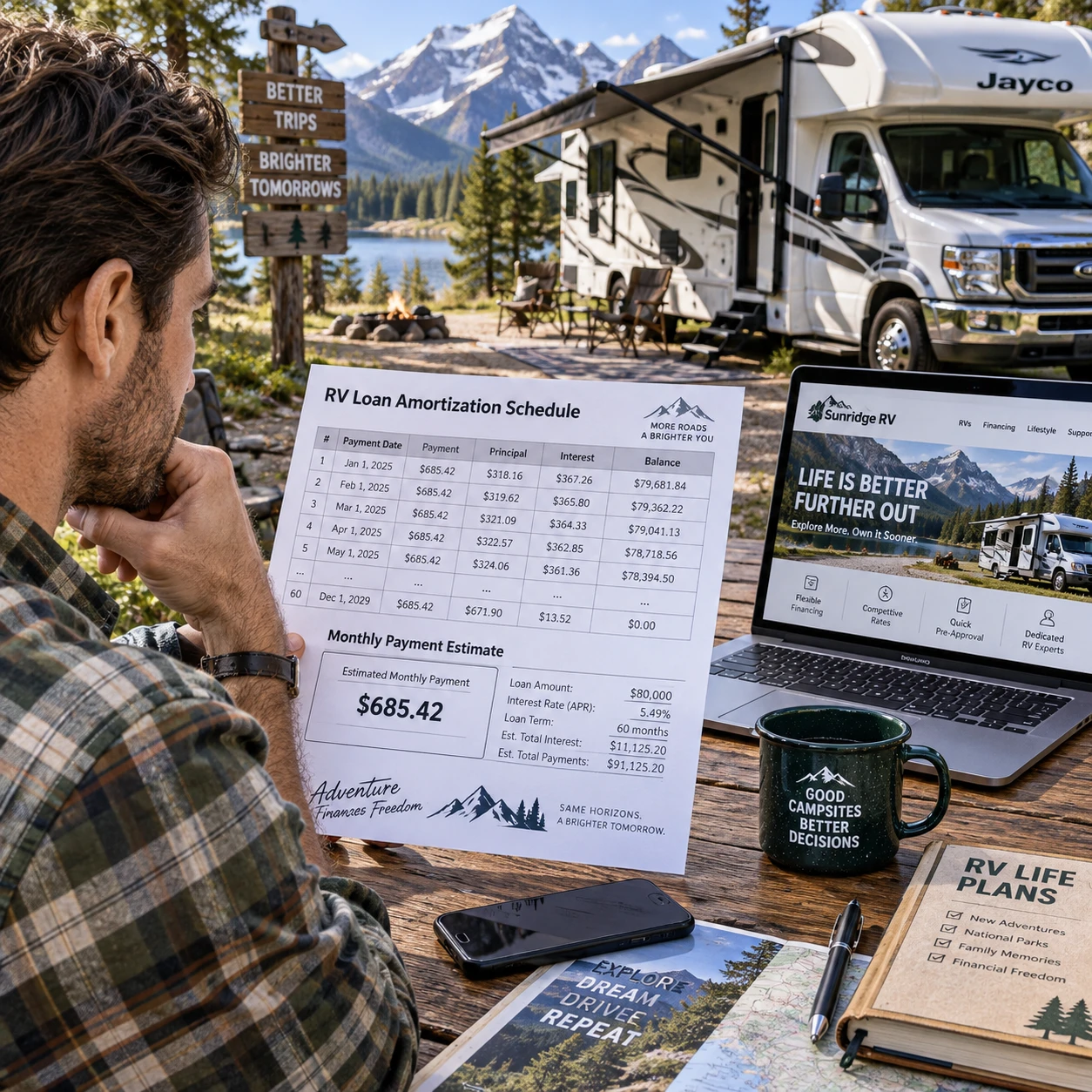
An RV loan can look manageable when you focus only on its monthly payment. But that payment also determines how quickly you reduce the principal, how much interest you pay, and what balance remains over time. Understanding amortization makes it easier to judge the full cost of a loan and compare repayment options.
Here’s how to read an RV amortization schedule, what affects your payment, and how an RV loan calculator can help you test different scenarios before you borrow.
What RV loan amortization means
RV loan amortization is the process of paying off a loan through scheduled payments that cover both interest and principal. With a typical fixed-rate loan, the payment amount stays the same, while the share going to interest generally falls and the share going to principal rises over time.
Principal is the amount you borrow. Interest is the cost charged for borrowing that amount, based on the loan’s interest rate and outstanding balance. At the start of a fully amortizing loan, the balance is higher, so more of a scheduled payment goes toward interest. As you pay down principal, interest is calculated on a smaller balance.
This is why a steady monthly payment does not reduce your balance by the same amount every month. The payment may be level, but its ingredients change. The exact schedule depends on details such as the rate, payment frequency, timing, and any fees included in the financing.
How an RV amortization schedule works
An RV amortization schedule shows each scheduled payment, how much goes to interest and principal, and the remaining balance after the payment. It lets you see the loan’s progress month by month rather than relying on the payment amount alone.
A schedule entry commonly includes:
- Payment number and date: When the payment is due in the schedule.
- Monthly payment: The amount due under the assumed loan terms.
- Interest portion: The amount applied to interest for that period.
- Principal portion: The amount that reduces what you owe.
- Remaining balance: The principal still unpaid after the payment is applied.
For a simplified illustration, imagine a $40,000 RV loan with a fixed 7% annual interest rate and a 10-year term, using monthly payments and no added fees. The estimated payment is about $465 per month. In the first month, roughly $233 would go to interest and $232 to principal. Later, less of each payment would cover interest because the balance would be lower. These figures are an illustration, not a lender quote.
Across the full schedule, the total of the payments minus the amount borrowed represents the estimated total interest, assuming you make every payment as scheduled and the loan terms stay unchanged.
Factors that affect your RV loan payments
Your RV loan payment is mainly affected by the amount financed, interest rate, loan term, and down payment. Changing any one of these inputs can alter your monthly payment, total interest, or both.
Amount financed and down payment
The amount financed is the portion of the purchase cost you borrow. A larger down payment usually means a smaller RV loan and lower scheduled payments, all else equal. The amount financed may also include eligible taxes, fees, or other costs if they are rolled into the loan, so check which items your estimate assumes.
Interest rate
A higher interest rate generally increases both the monthly payment and total interest for the same amount and term. Your offered rate can depend on lender criteria and the details of your application. A calculator’s assumed rate is useful for comparison, but it does not guarantee the rate a lender will approve.
Loan term
A longer loan term spreads repayment over more months and often lowers the required payment. The trade-off is that interest accrues for longer, so the total interest may be higher. A shorter term typically raises the monthly payment while reducing the time the balance remains outstanding.
Compare these factors together. A low payment may reflect a longer term rather than a lower borrowing cost. Choose a payment that fits your budget, then check how the term affects the total you repay.
How to use an RV loan calculator
To use an RV loan calculator, enter the amount financed, interest rate, and loan term, then review the estimated monthly payment and total repayment. Try several realistic combinations to understand how each input changes the result.
- Enter the loan amount. Use the amount you expect to borrow, not automatically the RV’s sticker price. Account for your down payment and any costs you plan to finance.
- Enter an interest rate. If you do not have a lender quote, test a reasonable range rather than treating one assumed rate as certain.
- Choose the loan term. Enter the repayment period in years or months, depending on the calculator.
- Review the results. Note the estimated monthly payment, total payments, total interest, and, if available, the amortization schedule and remaining balance.
- Change one input at a time. Comparing the same loan amount at different rates or terms helps show what is driving the cost.
Use the site’s RV loan calculator to explore payment scenarios before settling on a budget. Calculator results are estimates: lenders may use different payment dates, compounding conventions, fees, or final terms. Confirm the official payment schedule and annual percentage rate (APR) in the lender’s disclosures before agreeing to a loan.
What happens when you make extra payments
Extra payments can reduce an RV loan’s principal faster and may lower the interest you pay, provided the lender applies the extra amount to principal and the loan permits it. The effect depends on the contract and how the payment is processed.
Before paying extra, check whether the loan has a prepayment penalty, how to designate an additional principal payment, and whether the lender will keep your next due date unchanged or advance it. Simply paying more than the amount due does not always guarantee the extra goes where you intend.
When extra money is applied to principal, the balance falls sooner. Since future interest is generally calculated on the remaining balance, paying principal early can reduce later interest charges. The earlier the additional payment is made, the longer it may affect the schedule, but the actual savings depend on the rate, timing, and loan rules.
One practical approach is to ask the lender for an updated amortization schedule after an extra payment. That confirms how the payment was applied and shows the revised balance and payoff timeline. Keep an emergency cushion; reducing interest is helpful, but using cash needed for essential expenses can create a different financial problem.
How to use amortization when comparing RV loans
Use amortization to compare the monthly payment, total interest, and payoff timeline for each RV loan offer. Looking at all three makes it easier to spot when a smaller payment comes with a longer, more expensive repayment period.
For a fair comparison, keep the amount financed consistent and record each offer’s interest rate, APR, term, required monthly payment, fees, and total of payments. Then compare the schedules. If one loan has a lower payment, check whether that comes from a lower rate or simply a longer term.
A useful decision sequence is: first confirm that the required payment fits your budget; next compare total borrowing costs; then consider how quickly you want to pay off the RV. A shorter term can save interest but may leave less room in your monthly budget. A longer term can ease cash flow, but it usually keeps you in debt longer and may increase total interest.
Finally, treat every calculator result as a planning estimate, not a promised lender offer. The signed loan agreement controls the rate, fees, payment amount, and payoff rules. Read those terms carefully and compare the full repayment schedule before deciding.