How to Calculate RV Loan Payments: A Step-by-Step Guide

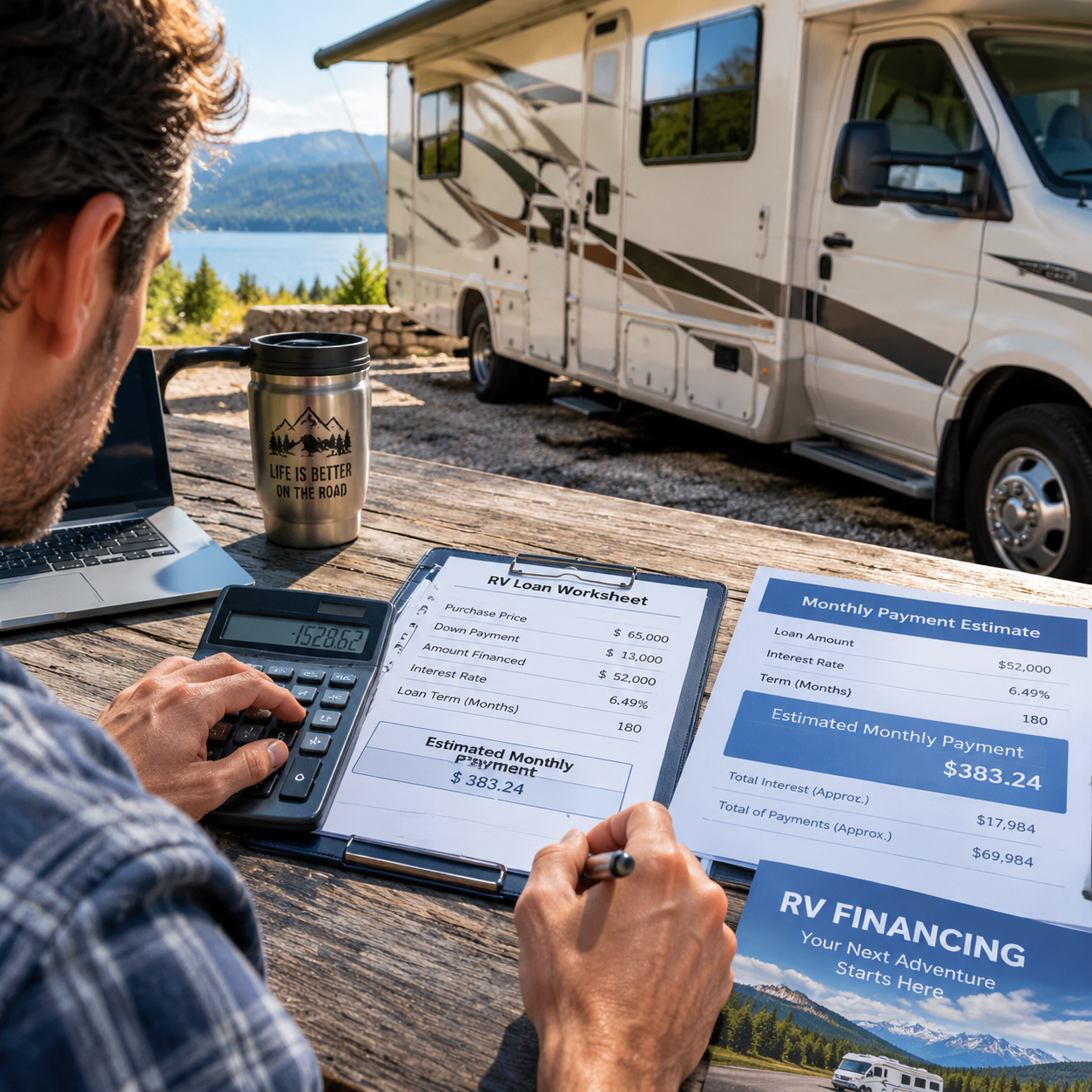
To calculate an RV loan payment, you need the amount financed, annual percentage rate (APR), and loan term. A standard fixed-payment formula can estimate monthly principal and interest, helping you compare scenarios before you apply. The result is an estimate, not a lender quote, and it does not automatically include insurance or other costs of owning an RV.
Below, you’ll gather the numbers, calculate the amount financed, apply the payment formula, and review a worked example. You’ll also see how a down payment, APR, term, and fees change the result.
Gather the details you need
To estimate an RV loan payment, gather the purchase price, down payment, amount financed, APR, loan term, and any fees added to the loan. These details determine the principal-and-interest payment for a fixed-rate loan.
Start with the price you expect to pay for the RV. Then find out how much you’ll pay upfront and what APR and repayment term a lender may offer. If you don’t have a formal offer yet, use clearly labeled estimates and test more than one scenario.
- Purchase price: The agreed cost of the RV, before any optional products or added charges.
- Down payment: The cash you pay toward the purchase. A trade-in may also reduce the amount you need to borrow.
- APR: The annual percentage rate, expressed as a yearly percentage. APR can reflect the interest rate and certain borrowing costs, but the exact fees included in a lender’s disclosed APR depend on the loan.
- Loan term: The time allowed for repayment, usually stated in months or years.
- Loan fees: Charges such as lender or documentation fees. They may be paid upfront or, if permitted, included in the amount financed.
Also check whether a lender’s quoted rate is fixed or variable. The formula below assumes a fixed rate and equal monthly payments. A variable rate can change, so its future payments may not follow the original estimate.
Calculate the amount you’ll finance
The RV loan amount is generally the purchase price plus eligible costs you finance, minus your down payment and any trade-in credit. This amount is the starting principal used to estimate the monthly payment.
Use this basic calculation:
Amount financed = purchase price + financed costs − down payment − trade-in credit
For example, if an RV costs $60,000, you put $10,000 down, and you finance $1,000 in eligible fees, the estimated amount financed is $51,000. If you pay those fees upfront instead, the amount financed would be $50,000, though you would need more cash at closing.
Fees and taxes are not handled the same way in every transaction. Some charges may be paid upfront, some may be rolled into the loan, and a lender may restrict what can be financed. Use the lender’s actual figures when available. Adding fees to the loan can reduce the cash needed at purchase, but it also means paying interest on those amounts over time.
Be careful not to subtract a down payment twice. If a dealer or lender already gives you an amount financed after credits and fees, use that figure directly rather than recalculating it from the purchase price.
Use the monthly loan payment formula
The standard fixed-payment formula estimates a monthly RV loan payment from the amount financed, monthly interest rate, and number of payments. It calculates a payment that repays principal and interest in equal monthly installments.
The formula is:
Monthly payment = P × [r(1 + r)n] ÷ [(1 + r)n − 1]
- P is the amount financed, or starting principal.
- r is the monthly interest rate, calculated as the annual rate divided by 12. For an APR of 7.2%, use 0.072 ÷ 12 = 0.006.
- n is the total number of monthly payments. A 10-year term has 120 payments.
The formula assumes a constant monthly rate and payments made on schedule. Early payments typically include a larger share of interest; as the principal falls, more of each payment goes toward principal. The formula estimates principal and interest only. It may not capture lender-specific payment timing, separate charges, or changes to a variable rate.
If you’d rather not calculate powers and fractions by hand, enter the same inputs into an RV loan payment calculator. Check that it asks for the amount financed, APR or interest rate, and loan term, and confirm whether its result includes any fees or additional products.
Work through a sample calculation
For a $50,000 RV loan at a fixed 7.2% APR over 10 years, the estimated monthly principal-and-interest payment is about $585. This illustrative calculation assumes 120 equal monthly payments and no additional charges in the payment.
Here are the inputs:
- Amount financed (P): $50,000
- Annual rate: 7.2%
- Monthly rate (r): 0.072 ÷ 12 = 0.006
- Term: 10 years × 12 = 120 payments
Substitute those figures into the fixed-payment formula: $50,000 × [0.006(1.006)120] ÷ [(1.006)120 − 1]. The result is approximately $585 per month. Multiplying that rounded payment by 120 gives roughly $70,200 in total payments, or about $20,200 above the original principal. Actual totals will vary with payment dates, rounding, fees, and the lender’s final terms.
This example is for comparison, not a financing offer. A lender may approve a different APR or term based on its criteria and your application. Before agreeing, compare the disclosed payment, amount financed, APR, total of payments, and any fees in the actual loan documents.
See what changes your RV payment
Your RV payment changes when the amount financed, APR, or loan term changes. A larger down payment usually lowers the payment by reducing principal, while a longer term usually lowers the monthly amount but increases the time interest can accrue.
Amount financed and down payment
Borrowing less generally means a lower monthly payment and less interest paid over the loan, all else being equal. A larger down payment can help achieve that, but it also uses cash that may be needed for taxes, setup costs, or emergency savings. Compare the payment reduction with the cash you’ll have left after purchase.
APR and loan term
A higher APR increases the cost of borrowing. A longer term spreads repayment across more months, which can make each payment smaller, but it often raises total interest. For example, extending a loan can make a monthly budget look easier while leaving you with a balance for more years. Compare both the monthly payment and total of payments, not just one number.
To compare offers fairly, hold the loan amount constant and test each APR and term separately. Then compare the same term across lenders. This simple approach helps show whether a lower payment comes from a better rate, a longer repayment period, or both.
Fees added to the loan
Financed fees increase the starting principal, so they can increase both the monthly payment and total interest. Paying eligible fees upfront has the opposite effect on the loan balance but requires more cash at the start. Confirm which charges are included in each estimate; a payment comparison can be misleading if one quote finances costs that another leaves out.
Estimate the full cost of owning an RV
An RV loan payment covers the scheduled loan obligation, usually principal and interest; it does not automatically include RV insurance, depreciation, maintenance, storage, or other ownership expenses. Estimate those costs separately to understand the broader monthly and annual budget.
RV insurance premiums depend on factors such as the vehicle, coverage, location, and insurer. Get an insurance quote for the specific RV and coverage you’re considering rather than using the loan calculator’s payment as a proxy. A separate RV insurance calculator can help organize an estimate, but the insurer’s quote determines the actual premium.
RV depreciation is the decline in a vehicle’s value over time. It is not a monthly loan charge, and it does not reduce the payment you owe. However, it matters when you estimate resale value or compare the loan balance with the RV’s market value. A depreciation calculator can model possible value changes, but the result is an estimate; condition, age, type, and market demand all affect resale prices.
For a more complete ownership estimate, list expenses separately:
- Monthly loan principal and interest
- RV insurance premiums
- Fuel, maintenance, and repairs
- Storage, registration, and applicable taxes
- Estimated depreciation and possible resale value
An RV loan payment calculator is useful for comparing financing scenarios, while insurance and depreciation calculators address different parts of ownership. Keep the assumptions visible, update estimates when you receive firm quotes, and avoid treating any online result as a guaranteed lender or insurer figure.
RV loan payment FAQs
These answers clarify what a payment estimate includes and how to handle missing or changing loan details. For a reliable comparison, use the same assumptions across every calculation.
Does an RV loan payment include insurance?
Usually, the calculator’s loan payment shows principal and interest only. Insurance may be required by a lender, but its premium is a separate cost unless a specific arrangement says otherwise. Check the loan estimate and your insurance documents.
How does a longer loan term affect the monthly payment and total interest?
A longer term generally lowers the monthly payment because the balance is divided across more payments. It can increase total interest because you borrow for longer. Compare the monthly amount with the total paid over the full term.
Can I calculate an RV payment without knowing my exact APR?
Yes. Use a clearly labeled estimated APR and calculate a range of scenarios. For example, test several rates around the figure you expect, then replace the estimate with the lender’s actual offer before making a decision.
Should I include fees in the amount financed?
Include a fee only if it will actually be financed under the lender’s terms. If you’ll pay it upfront, leave it out of the loan amount and account for it separately in your cash budget. Financing a fee increases the balance and may increase interest paid.