Understanding RV Depreciation: How Much Value Does Your RV Lose Each Year?

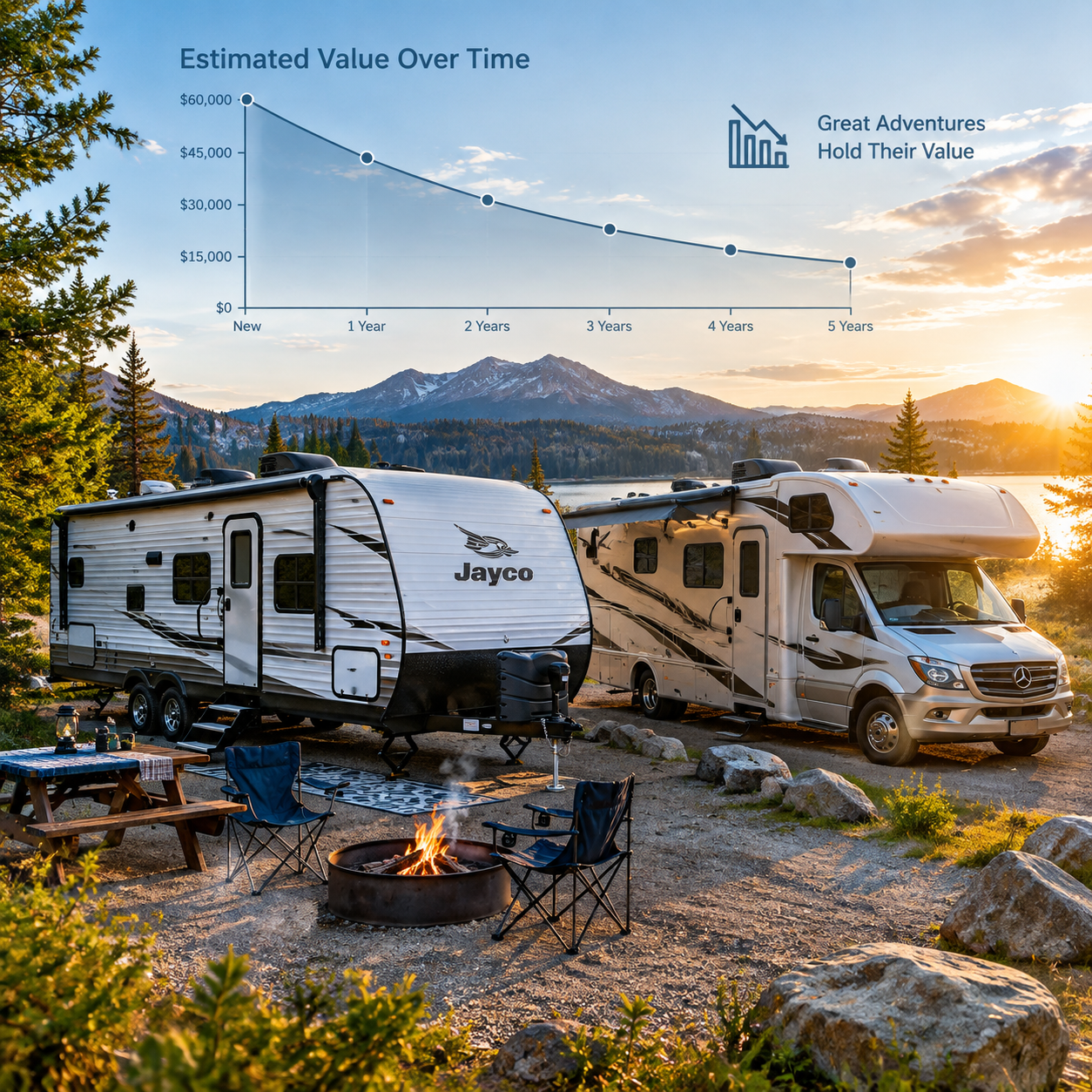
RV depreciation is the drop in an RV’s value as it ages, gets used, and responds to changes in the market. The amount varies: a motorhome, travel trailer, or fifth wheel can follow a different value pattern, and no single annual rate applies to every RV.
Understanding depreciation helps you set realistic expectations before buying, selling, or trading in. It can also clarify why your RV’s estimated market value and the amount you owe on its loan may not match.
What RV depreciation means
RV depreciation is the reduction in an RV’s estimated value over time. Resale value is what a buyer may pay in a private sale, while your loan balance is what you still owe the lender; those three figures are related but not interchangeable.
For example, if you paid $80,000 for a motorhome and its estimated current market value is $60,000, its value has fallen by $20,000. That difference is depreciation in dollar terms, though it does not tell you the RV’s precise selling price or your remaining loan balance.
Depreciation is an estimate of value change, not a bill. Actual resale value depends on the RV’s condition, location, season, demand, and the terms of the sale. A dealer’s trade-in offer may be lower than a private-sale estimate because the dealer must account for inspection, reconditioning, overhead, and resale risk.
Loan payments follow a separate schedule. Early in some loan terms, a larger share of each payment goes toward interest, so the principal may decline more slowly than the RV’s estimated value. That can leave an owner with negative equity, meaning the loan balance is higher than the RV’s current market value.
How RV value can change over time
RV value often drops fastest early in ownership, then changes at a different pace as the vehicle ages. The exact pattern depends on the RV and market, so a fixed annual depreciation schedule is only a rough planning assumption.
A new RV may lose value after purchase as it becomes a used vehicle, but there is no reliable percentage that fits every make, model, or year. A lightly used travel trailer in strong demand may hold value differently from a large motorhome with higher mileage or costly systems to maintain.
Value changes can also speed up or slow down with external conditions. Fuel prices, interest rates, inventory levels, new-model pricing, and shifts in travel demand can influence what buyers are willing to pay. A market estimate made during a period of high demand may not hold once supply increases.
Think of an RV’s value path as a curve rather than a straight line: purchase price, age, condition, and current demand all shape the result. An estimate is most useful as a planning range, not a promise of what a buyer will offer.
Factors that affect an RV’s depreciation
RV depreciation depends on the vehicle’s type, age, use, condition, maintenance history, features, and the market for similar units. These factors work together, so two RVs of the same model year can have different resale values.
- RV type and model: Motorhomes combine a living space with a vehicle chassis and engine, while travel trailers and fifth wheels are towable. Their buyers, maintenance needs, and comparable listings differ, so their depreciation patterns can differ too.
- Age and mileage: Age affects appliances, seals, tires, and interior materials. For motorhomes, mileage can matter because it reflects use of the engine and drivetrain. For towables, buyers may focus more on condition, storage, and signs of use than on a single mileage figure.
- Condition and maintenance: Water intrusion, roof or seal problems, neglected tires, and malfunctioning appliances can reduce buyer confidence. Regular service and prompt repairs help protect usability, although maintenance costs do not always add the same amount to resale value.
- Features and floor plan: Practical layouts, sought-after amenities, and equipment in good working order can help an RV appeal to more buyers. Highly personalized upgrades may not return their full cost if the next owner does not value them.
- Market demand and location: Local inventory, season, fuel costs, and buyer preferences affect offers. A model that is popular in one area may attract fewer buyers elsewhere.
Compare your RV with similar units of the same type, model, age, and condition. Listings are useful for understanding asking prices, but they are not proof that a vehicle sold for that amount.
How to estimate your RV’s depreciation
To estimate RV depreciation, compare the purchase price with a current value estimate, then divide the difference by the number of years you have owned it. An RV depreciation calculator can help project future values, but its result is an estimate rather than a guaranteed sale price.
Use this simple calculation:
- Total depreciation: purchase price − estimated current value.
- Average annual depreciation: total depreciation ÷ years owned.
- Estimated depreciation rate: total depreciation ÷ purchase price × 100.
For example, suppose an RV cost $80,000 and a current estimate is $60,000 after four years. The estimated value loss is $20,000, or an average of $5,000 per year. That average describes the period as a whole; it does not mean the RV lost exactly $5,000 in each year.
For a more useful projection, enter a reasonable starting value, select a time period, and compare several depreciation assumptions in an RV depreciation calculator. Check the result against recent listings for comparable RVs, adjusting for condition and equipment. If you are budgeting a purchase, pair that estimate with an RV loan calculator to compare possible loan payments with projected value over time.
Keep the estimate conservative if you have limited information. A calculator cannot inspect the RV, account for every local market shift, or guarantee a dealer’s offer.
Depreciation’s effect on resale, trade-in, and loan equity
Depreciation affects how much you may receive when selling or trading in, and it can create a gap between the RV’s market value and your loan balance. Checking both numbers before a sale helps you understand whether the proceeds may cover what you owe.
In a private sale, the seller may have more control over the asking price but also takes on advertising, buyer questions, inspections, and paperwork. A trade-in is often simpler, though the offer may be lower than a private-sale price. Compare the total deal, including any purchase discount or fees, rather than judging a trade-in offer in isolation.
To estimate RV equity, subtract the loan payoff amount from the RV’s likely market value:
- If the value is $60,000 and the payoff is $52,000, estimated equity is $8,000.
- If the value is $60,000 and the payoff is $65,000, you have about $5,000 in negative equity.
The lender’s payoff quote may differ from the balance shown on a recent statement because of accrued interest or other loan terms. Ask the lender for a current payoff amount before agreeing to a sale or trade. If negative equity exists, you may need to pay the difference, negotiate the transaction, or wait while making payments and reassessing value. Rolling unpaid debt into a new loan can increase the amount financed and prolong the time before you build positive equity.
Ways to help preserve RV value
You can help preserve RV value by preventing avoidable damage, following maintenance schedules, storing the vehicle carefully, and keeping clear service records. These steps do not stop depreciation, but they can support condition and buyer confidence.
- Maintain the roof, seals, and tires. Inspect for leaks and wear, and address problems promptly. Small water-entry issues can become expensive repairs if left unchecked.
- Follow the manufacturer’s service schedule. Keep up with engine, chassis, generator, appliance, and other system maintenance as applicable to your RV.
- Store it thoughtfully. Covered or sheltered storage can reduce exposure to sun, weather, and debris. Storage has a cost, so weigh that expense against the protection it offers in your climate.
- Keep receipts and records. Save maintenance invoices, repair details, manuals, and warranty information. Organized documentation makes it easier for a buyer to understand how the RV was cared for.
- Keep changes practical. Useful upgrades may improve livability, but expensive customizations rarely guarantee an equal increase in resale value.
Before listing, clean the RV, test major systems, and disclose known issues honestly. A well-presented unit can attract more serious interest, but an asking price should still reflect comparable vehicles and actual condition.
Frequently asked questions
Do all RV types depreciate at the same rate? No. Motorhomes, travel trailers, and fifth wheels differ in design, maintenance needs, buyer demand, and market conditions. Even RVs of the same type can lose value at different rates.
Does mileage affect an RV’s value? Mileage can matter more for motorhomes because it indicates use of the engine and drivetrain. For a travel trailer or fifth wheel, buyers often pay close attention to age, condition, storage, and maintenance instead.
How can I estimate my RV’s current resale value? Compare recent listings for similar models, years, and condition, then account for location and equipment. A depreciation calculator can provide a planning estimate, but listings and calculator results do not guarantee a completed sale price.
Can my RV loan balance be higher than its value? Yes. If the RV depreciates faster than the loan principal falls, the balance can exceed its estimated market value. Check a current lender payoff quote and compare it with realistic private-sale or trade-in estimates.